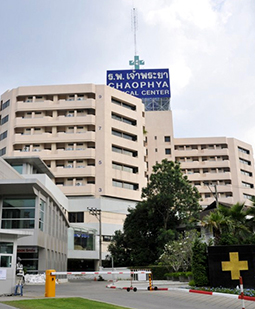
The Chaophya Hospital is a JCI accredited, tertiary private hospital in Bangkok, Thailand, which has been in operation since 1991. It has an international department which offers a comprehensive range of supporting services to foreign patients.
DoctorsKDProf. Kritvikrom DurongpisitkulMTProf. Montri TuchindaView all 33
Vejthani is a 500 bed private hospital that serves international patients from over 40 countries annually. The hospital has all necessary services to accomodate medical tourists.
DoctorsTCProf. Teerachai Chantarojsiri, MD.APAssist. Prof. Voranush ChongsrisawatView all 26
Piyavate Hospital is a 300 bed tetriary care hospital with an International coordinator team to take care of all the international patient's needs. It has been in operation since 1993.
Being established in 1993, this tertiary private medical institution offers a wide range of medical care services. It has 350 in-patient bed capacity and is accredited by the Hospital Accreditation of Thailand.
DoctorsPRDr. Prapasri RangsiyanondTVDr. Thamnium VaseenonView all 21
This is a medical subspecialty that focuses on diseases and disorders of the ear, nose and throat in infants, children and adolescents. It is also referred to as pediatric otolaryngology.
Who is a pediatric ENT specialist?
Pediatric ENT specialists are also referred to as pediatric otolaryngologists. They are medical doctors who have special skills, training and expertise on conditions of the ear, nose and throat that affect children. Their special skills uniquely equip them with the expertise needed to treat various disorders and diseases ranging from common infections to complex conditions that are congenital or acquired.
Why see a pediatric ENT specialist?
The specialist provides multidisciplinary care through a team approach. This includes pediatric experts from various disciplines such as neonatology, plastic surgery, audiology, speech and language pathology, radiology anesthesia and others.
Common conditions treated
Ear: Ear infections, perforated ear drums, foreign bodies, cysts and pits, hearing loss, cholesteatoma and congenital malformations.
Nose: Nasal obstruction, foreign bodies, polyps nasal masses, congestion, allergies, deviated septum, sinusitis, nose bleeds, nasal fractures and trauma, and choanal atresia.
Ear Tube Surgery: This procedure may be required if your child has an ear infection for a prolonged time. It may also be appropriate if your child has multiple complicated ear infections within a short time. Ear tube surgery may also be required if your child has a build u of fluid behind the eardrum. This fluid buildup may lead to language and speech delays. Insertion of ear tubes prevents further buildup of fluid and pressure and improves hearing.
Tonsillectomy and Adenoidectomy : Tonsils and adenoids are located in the back of the throat. They help protect the body form infections because they trap germs that enter via the mouth and nose. If your child’s tonsils and adenoids have severe infections your doctor may recommend a tonsillectomy and/or adenoidectomy. These surgeries are removed to prevent further infection. The procedure may also be performed if your child’s adenoids and tonsils become enlarged affecting their breathing as they sleep. Enlarge ENT of the tonsils and adenoids usually cause the child to snore or have brief stops in the breathing pattern called sleep apneas.
Pediatric Sinus Surgery: Sinuses are air filled cavities in the bones of the face. Sinusitis occurs when the sinuses become inflamed or infected. Sinusitis can cause blockage of the natural opening of the sinuses. Such blockages can also occur when your child has flu, cold, bacterial infection or allergies. Sinus surgery may be recommended if your child suffers repeated sinusitis which does not resolve with medical therapy.
Pediatric Sleep Apnea Surgery: Sleep apnea is a condition that occurs when during sleep your child’s breathing becomes completely or partially blocked. It is due to blockage of the upper airway. After careful evaluation your doctor may recommend pediatric sleep apnea surgery.
Pediatric Neck Mass Surgery: This surgery may be recommended if your child has a congenital neck mass. This is a growth in the neck and as the child grows older, it may grow larger.
Frenuloplasty: Ankyloglossia (Tongue Tie) is a condition that decreases the tongue’s mobility. It results in the tongue being anchored to the mouth’s floor by the frenulum (a band of tissue). When the frenulum is too short the tongue is unable to move properly which leads to feeding and speech problems. Frenuloplasty is performed with the aim of releasing the frenulum to allow for improved movement of the tongue.
About Pediatric E.N.T
Key facts to plan your treatment: how long it takes, your hospital stay, anaesthesia, risks and recovery.
Recovery
Information coming soon. Request a consultation for personalized recovery guidance. Get Quote →
After care
Information coming soon. Request a consultation for personalized recovery guidance. Get Quote →

 Private Hospital
 JCI
 ISO



 Thai HA