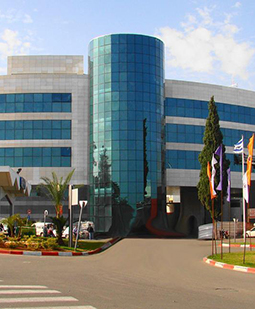
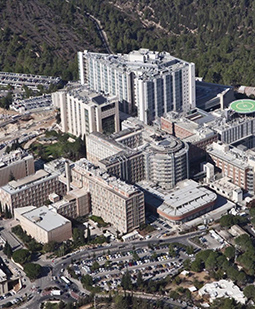
The largest medical center in Israel and the Middle East, internationally renowned for it's medical excellence. Around 31,000 inpatients are treated annually.
DoctorsM(Prof. Mordechai (motti) GutmanYGDr. Yuri GoldesView all 6
A private hospital located on the shorelines of Herzliya, just off Tel Aviv, offering healthcare services to both local and foreign patients. The hospital is affiliated with over 500 Israeli physicians, many of whom hold high level positions at public hospitals.
DoctorsGLDr. Guttman LiveDRDr. David R. NeufeldView all 88
The second largest hospital in Israel, Rabin Medical Center is a tertiary care hospital that can handle the most complicated cases in all medical fields.
DoctorsZDProf. Zeev DreznikAProf. A.ZelikovskiView all 4
One of the largest hospitals in Israel with 900 beds and 700 physicians. The hospital serves 1000 medical tourists annually, providing advanced medical care at the highest western standards.
Hadassah medical institution includes two university hospitals in Jerusalem – on Mt. Scopus and in Ein Kerem. Both provide advanced tetriary healthcare services in all medical specialties.
What is Spleen Removal Surgery?
Spleen removal surgery, known as splenectomy, is a surgical procedure in which a diseased or damaged spleen is partially or completely removed.
How is Splenectomy Performed?
Spleen removal surgery can be performed by an open surgery or by a laparoscopic method. The surgery may be done to completely remove the spleen that is enlarged or ruptured, or the spleen may also be partially removed.
Open-complete splenectomy to remove an enlarged spleen
An incision is made in the middle of the abdomen, or on the left side of the abdomen below the ribs.
The artery connected to the spleen is tied to avoid blood loss.
The ligaments that hold the spleen are detached and the spleen is removed.
If required, tissue samples are extracted and sent for lab analysis.
After the surgery is over, the incision is closed.
Open-complete splenectomy to remove a ruptured spleen
An incision is made in the middle of the abdomen, or on the left side of the abdomen below the ribs.
The spleen is approached from the underside and the artery connected to the spleen is tied.
The ligaments that hold the spleen are detached and the ruptured spleen is removed.
After the surgery is over, the incision is closed.
Partial splenectomy
Sometimes only part of the spleen is removed to reduce pain that is caused by an enlarged spleen.
In partial splenectomy, the patient is less vulnerable to infection.
Laparoscopic splenectomy
A laparoscopic splenectomy may be performed if the spleen is less than 20 centimeters long, when measured in a CT scan.
Three to five incisions are made on the patient’s abdomen.
A laparoscope, which is an endoscopic instrument with a light and camera attached to it, is inserted through one of the incisions.
Other surgical instruments are inserted through the other incisions.
Gas is pumped into the abdomen to inflate it, so that the surgeon gets more space to work.
The spleen is removed using the laparoscope and other surgical instruments.
How to Prepare for the Spleen Removal Surgery?
The patient needs a complete physical check up.
Some blood tests and imaging tests are also required.
Blood transfusion may also be required.
The patient may need some immunization vaccines.
If the patient is a smoker, the patient should quit smoking some weeks before the surgery.
Certain medications that the patient may be taking should be stopped a week before the surgery.
The patients should inform the doctor about any ailments and medical conditions.
About Spleen Removal Surgery
Key facts to plan your treatment: how long it takes, your hospital stay, anaesthesia, risks and recovery.
Days admitted
Less than a week for an open splenectomy;
one to two days for a laparoscopic splenectomy.
Anesthesia
General anesthesia
Recovery
- After the surgery, the patient may require blood transfusion to replace diseased blood cells.
- Some patients may be able to return to work in a few days after the surgery, while others may need a longer period of rest.
- The patient can recover and resume normal activities in 4 to 6 weeks.
Risks
- Injury to other organs
- Post-splenectomy sepsis
- Blood clot in the portal vein
- Collapsed lung
- Heart attack or stroke
- Blood loss
- Blood clot
- Infection
- Breathing problems
After care
- After the surgery, the patient may require blood transfusion to replace diseased blood cells.
- Some patients may be able to return to work in a few days after the surgery, while others may need a longer period of rest.
- The patient can recover and resume normal activities in 4 to 6 weeks.

 Public Hospital
 JCIPrice on request



 ISO